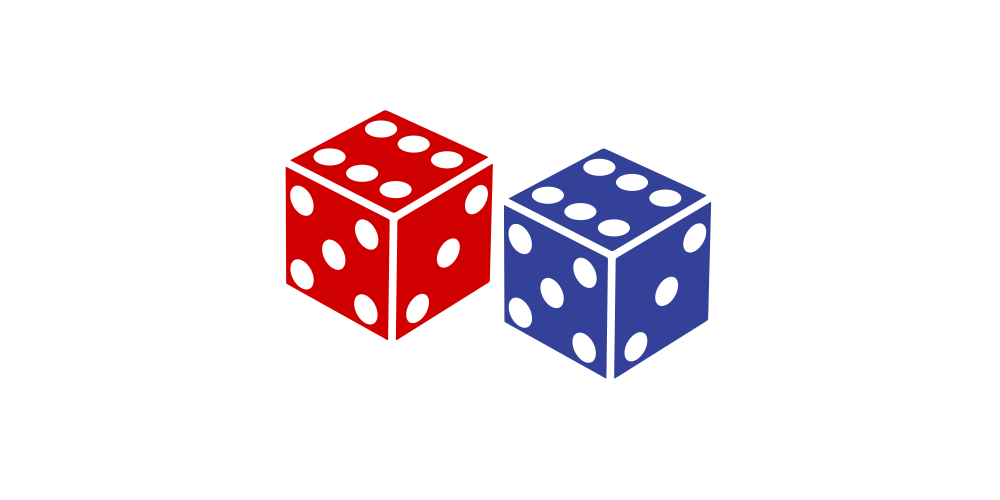
| Roll | 1 | 2 | 3 | 4 | 5 | 6 |
|---|---|---|---|---|---|---|
| 1 | 2 | 3 | 4 | 5 | 6 | 7 |
| 2 | 3 | 4 | 5 | 6 | 7 | 8 |
| 3 | 4 | 5 | 6 | 7 | 8 | 9 |
| 4 | 5 | 6 | 7 | 8 | 9 | 10 |
| 5 | 6 | 7 | 8 | 9 | 10 | 11 |
| 6 | 7 | 8 | 9 | 10 | 11 | 12 |
7|PROBABILITY
Probability and games
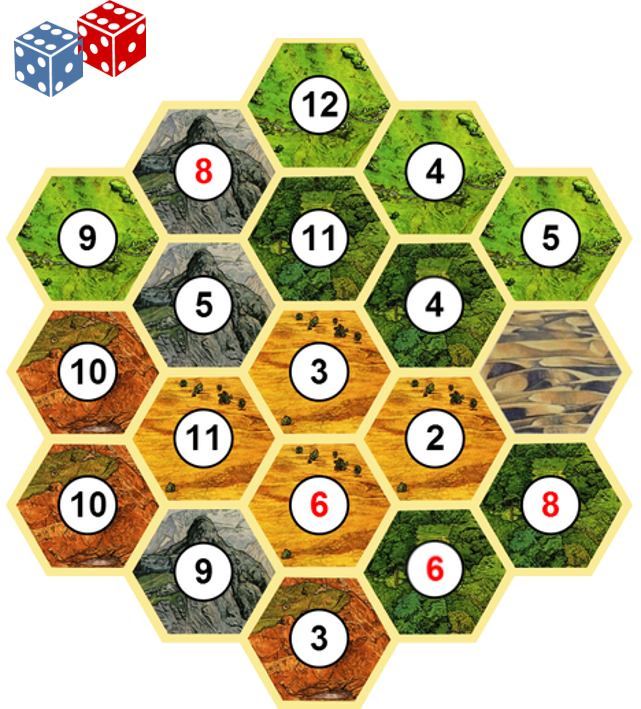
- Settlers of Catan
- Board of hex tiles, each with a number
- Place “settlements” at intersection of tiles
- Each turn, roll 2 dice
- You get resources if your settlement is touching the rolled total
- Where do you put your first settlement?
Example: coin flip
- E.g. Flipping a coin
- Numerator: number of those outcomes
- Denominator: all possible outcomes
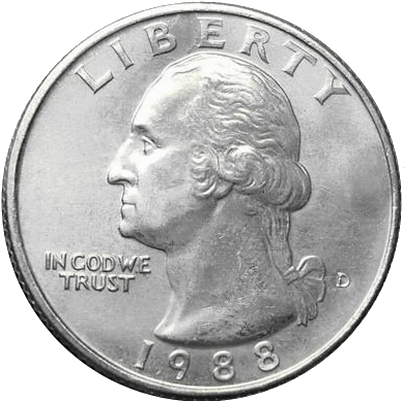
\(p(heads) = 1/2 = .5\)

\(p(tails) = 1/2 = .5%\)
Example: rolling dice
- All possible outcomes:
- 1, 2, 3, 4, 5, 6
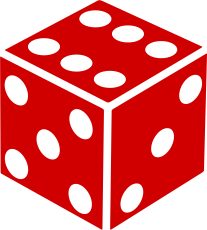
\(p(6) = 1/6 = 0.17\)
\(p(1) = 1/6 = 0.17\)
\(p(odd) = 3/6 = 0.5\)
Example: rolling 2 dice
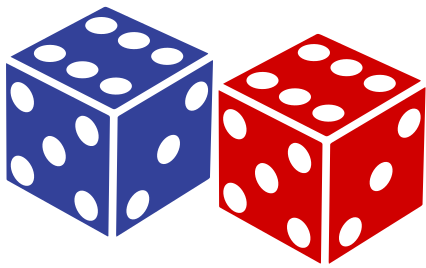
\(p(2) = 1/36 = .03\)
\(p(12) = 1/36 = .03\)
\(p(7) = 6/36 = .17\)
Sampling marbles
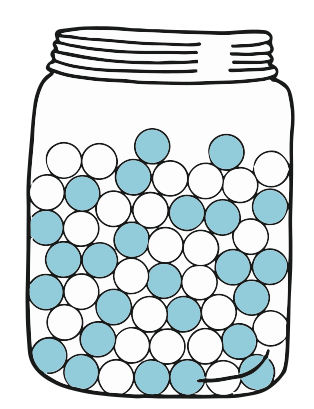
- Jar of marbles
- Contains 25 white & 25 blue marbles
- What is the probability of randomly drawing a white marble?
- Number of those outcomes (25)
- Divided by total number of outcomes (50)
\(p(white) = 25/50 = .5\)
More marbles
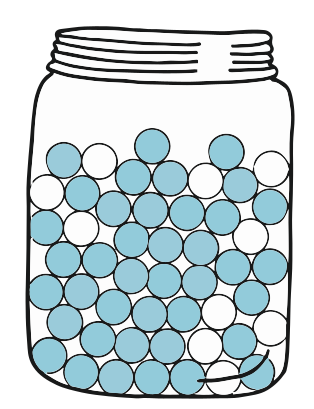
- Different jar
- 40 blue & 10 white marbles
- What is the probability of randomly drawing a white marble?
\(p(white) = 10/50 = .2\)
Repeated sampling
- Repeated sampling
- 40 blue, 10 white
- What is the probability of randomly drawing one white marble and then drawing a second white marble?
\(p(first \ white) = 10/50 = .2\)
\(p(second \ white)\) depends on whether we put the first one back or not
Repeated sampling
- Without replacement
\[\begin{align} p(white) & = 10/50 = .2 \\ p(second \ white) & = 9/49 \approx .18 \\ p(both \ white) & = .2 * .18 \approx .037 \end{align}\]
- With replacement
\(\begin{align} p(white) &= 10/50 = .2 \\ p(second \ white) &= 10/50 = .2 \\ p(both \ white) &= .2 * .2 = .04\end{align}\)
Probability and distributions
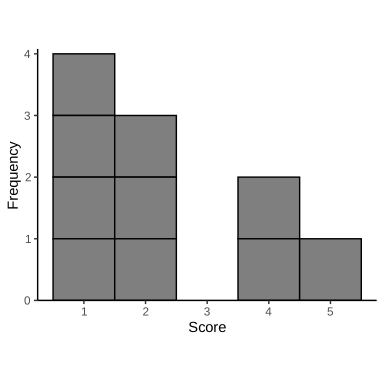
\(p(X = 1) = 4/10 = 0.4\)
\(p(X \ge 4) = 3/10 = 0.3\)
\(p(1 \lt X \lt 5) = 5/10 = .5\)
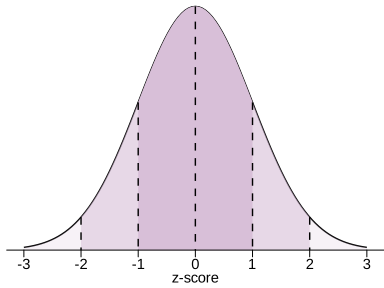
Probability and z-scores
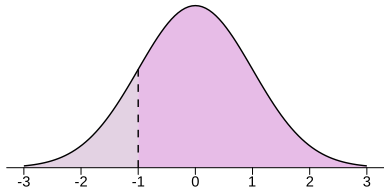
- Normal distribution
- Symmetrical
- Highest frequency in the middle
- Tapers off towards the extremes
- Very common distribution shape
- Defined by an equation
- Can be described by the proportions of area contained in each section
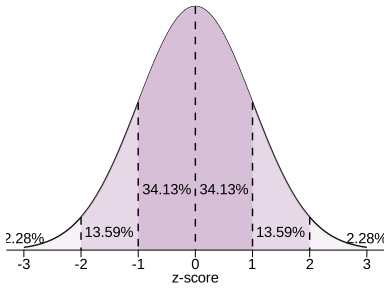
\(Y = \dfrac{1}{\sqrt{2 \pi \sigma^2}}e^{-(X-\mu)^2 / 2\sigma^2}\)
Unit Normal Table
| \(z\) | Proportion in body | Proportion in tail | Proportion between \(M\) and \(z\) |
|---|---|---|---|
| 0.0 | 0.5000 | 0.5000 | 0.0000 |
| 0.1 | 0.5398 | 0.4602 | 0.0398 |
| 0.2 | 0.5793 | 0.4207 | 0.0793 |
| 0.3 | 0.6179 | 0.3821 | 0.1179 |
| 0.4 | 0.6554 | 0.3446 | 0.1554 |
| 0.5 | 0.6915 | 0.3085 | 0.1915 |
| 0.6 | 0.7257 | 0.2743 | 0.2257 |
| 0.7 | 0.7580 | 0.2420 | 0.2580 |
| 0.8 | 0.7881 | 0.2119 | 0.2881 |
| 0.9 | 0.8159 | 0.1841 | 0.3159 |
| 1.0 | 0.8413 | 0.1587 | 0.3413 |
| 1.1 | 0.8643 | 0.1357 | 0.3643 |
| 1.2 | 0.8849 | 0.1151 | 0.3849 |
| 1.3 | 0.9032 | 0.0968 | 0.4032 |
| 1.4 | 0.9192 | 0.0808 | 0.4192 |
| 1.5 | 0.9332 | 0.0668 | 0.4332 |
| 1.6 | 0.9452 | 0.0548 | 0.4452 |
| 1.7 | 0.9554 | 0.0446 | 0.4554 |
| 1.8 | 0.9641 | 0.0359 | 0.4641 |
| 1.9 | 0.9713 | 0.0287 | 0.4713 |
| 2.0 | 0.9772 | 0.0228 | 0.4772 |
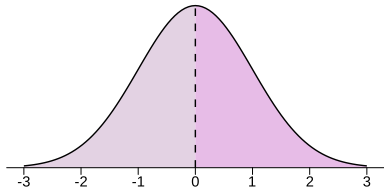
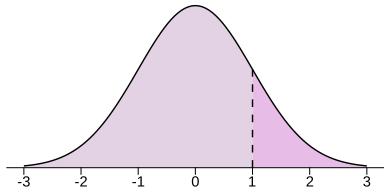
Spiderman
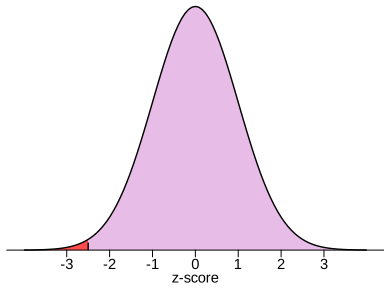
- Are Peter Parker’s RTs “noticeably different?”
- \(z = -2.5\)
- Can state precise probability of observing a \(z\)-score that (or more) extreme

Warning
- Probabilities given in the Unit Normal Table will be accurate only for normally distributed scores
- Shape of the distribution must be verified
- Important assumption of Central Limit Theorem