8|SAMPLING
Overview
Roadmap
- So far…
- \(z\)-scores describe the location of a single score in a sample or in a population
- Normal distributions: precisely quantify probability of obtaining certain scores
- Moving forward…
- Quantifying probability of obtaining certain sample statistics
Sampling error
Sampling error
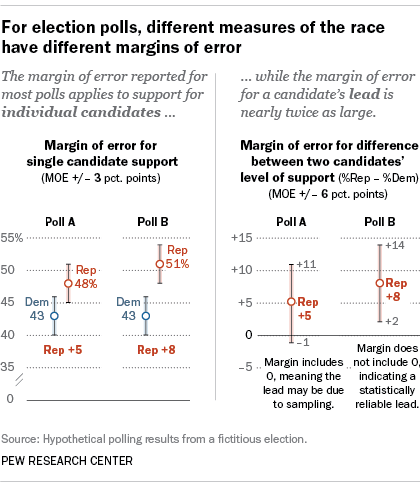
- Error: Discrepancy between a sample statistic and the population parameter
Sampling error
- Discrepancy between a sample statistic and the population parameter
- E.g. Opinion polling
- see Pew explainer
Sampling error: IQ
Distribution of Sample Means
- “Distribution of Sample Means” / “Sampling distribution of the mean”
- Distribution of sample means obtained by selecting all possible samples of size \(n\) from a population
- Often huge number of possible samples
- But distribution forms a simple & predictable pattern
Characteristics
- Shape
- The distribution will be approximately normal
- Sample \(M\)s are representative of population \(\mu\)
- Most means will be close to \(\mu\); means far from \(\mu\) are rare
- Center
- The center/average of the distribution will be close to \(\mu\)
- \(M\) is a unbiased statistic
- On average, \(M = \mu\)
- Variability
- Related to sample size, \(n\)
- The larger the sample, the less the variability
- Larger samples are more representative
Example: height distribution
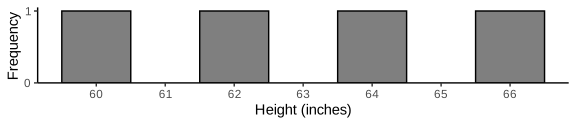
Example: height distribution
| Sample | X1 | X2 | M |
|---|---|---|---|
| 1 | 60 | 60 | 60 |
| 2 | 62 | 60 | 61 |
| 3 | 64 | 60 | 62 |
| 4 | 66 | 60 | 63 |
| 5 | 60 | 62 | 61 |
| 6 | 62 | 62 | 62 |
| 7 | 64 | 62 | 63 |
| 8 | 66 | 62 | 64 |
| 9 | 60 | 64 | 62 |
| 10 | 62 | 64 | 63 |
| 11 | 64 | 64 | 64 |
| 12 | 66 | 64 | 65 |
| 13 | 60 | 66 | 63 |
| 14 | 62 | 66 | 64 |
| 15 | 64 | 66 | 65 |
| 16 | 66 | 66 | 66 |
Sampling distribution (\(n = 2\))
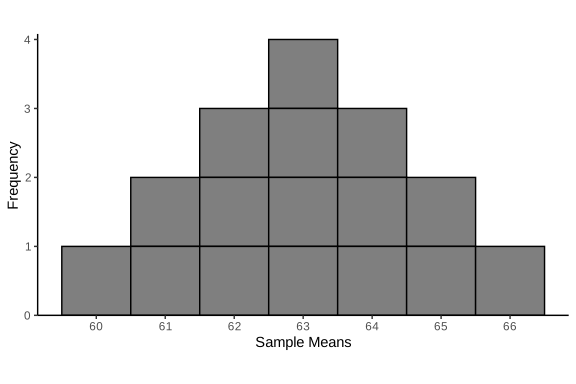
\(p(M < 61) =\ ?\)
\(p(62 \le M \le 64) =\ ?\)
\(p(M > 65) =\ ?\)
Example: height distribution
- Now we can calculate variability of sample means
- Since we obtained every sample mean
- Use population SD formula
| \(X\) | \(X-M\) | \((X-M)^2\) |
|---|---|---|
| 60 | -3 | 9 |
| 61 | -2 | 4 |
| 62 | -1 | 1 |
| 63 | 0 | 0 |
| 61 | -2 | 4 |
| 62 | -1 | 1 |
| 63 | 0 | 0 |
| 64 | 1 | 1 |
| 62 | -1 | 1 |
| 63 | 0 | 0 |
| 64 | 1 | 1 |
| 65 | 2 | 4 |
| 63 | 0 | 0 |
| 64 | 1 | 1 |
| 65 | 2 | 4 |
| 66 | 3 | 9 |
| \(M = 63.00\) | \(SS = 40.00\) | |
| \(\sigma^2 = 2.50\) | ||
| \(\sigma = 1.58\) |
Central Limit Theorem
- Sampling & the Central Limit Theorem
- Distribution of samples means based on all possible samples from a population not feasible in most realistic situations
- But we can mathematically predict shape, mean, & variability for any sample size & population
Central Limit Theorem
- For any population with mean \(\mu\) and standard deviation \(\sigma\), the distribution of sample means for sample size \(n\) will have…
- An expected mean \(\mu_M\) of \(\mu\)
- A standard deviation of \(\dfrac{\sigma} {\sqrt{n}}\)
- And will approach a normal distribution as \(n\) approaches infinity
Shape
- Almost perfectly normal in either of two conditions
- The population from which the samples are selected is a normal distribution
- Or…
- Sample \(n\)s are relatively large
- …what is relatively large?
- As \(n\) approaches infinity, distribution of sample means approaches a normal distribution
- But by \(n = 30\) means pile up symmetrically around \(\mu\)
- Population distribution does not need to be normal; can be skewed, flat, bimodal, whatever
Mean
- Mean of the distribution of sample means is called the expected value of \(M\) ( \(\mu_M\) )
- On average, \(M = \mu_M = \mu\)
- \(M\) is unbiased
- If we only have a single sample \(M\), our best guess at the (unknown) population mean should always be the (known) sample mean
- But we can acknowledge variability…
Variability
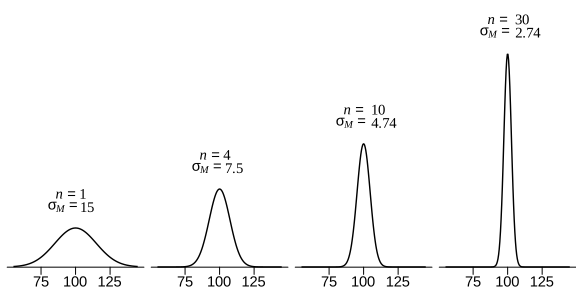
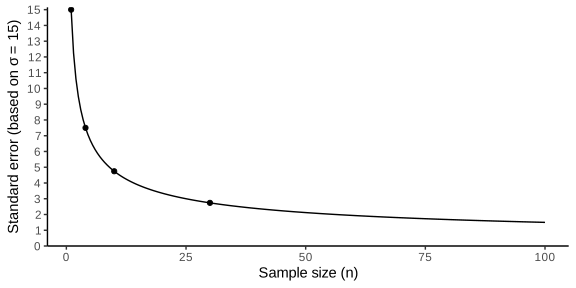
- Standard deviation of the sample means
- “Standard error of the mean”; \(\sigma_M\)
- Measure of how well a sample mean estimates its population mean
- How much sampling error we can expect; how much distance is expected on average between \(M\) and \(\mu\)
\(\sigma_M = \dfrac{\sigma}{\sqrt{n}}\) or \(\dfrac{\sqrt{\sigma^2}}{\sqrt{n}}\) or \(\sqrt{\dfrac{\sigma^2}{n}}\)
Variability
Variability
Variability
30
σM =
Variability: heights sampling dist
| Sample | X1 | X2 | M |
|---|---|---|---|
| 1 | 60 | 60 | 60 |
| 2 | 62 | 60 | 61 |
| 3 | 64 | 60 | 62 |
| 4 | 66 | 60 | 63 |
| 5 | 60 | 62 | 61 |
| 6 | 62 | 62 | 62 |
| 7 | 64 | 62 | 63 |
| 8 | 66 | 62 | 64 |
| 9 | 60 | 64 | 62 |
| 10 | 62 | 64 | 63 |
| 11 | 64 | 64 | 64 |
| 12 | 66 | 64 | 65 |
| 13 | 60 | 66 | 63 |
| 14 | 62 | 66 | 64 |
| 15 | 64 | 66 | 65 |
| 16 | 66 | 66 | 66 |
Sampling distribution (\(n = 2\))
\(\sigma_M = \dfrac{\sigma}{\sqrt{n}} = \dfrac{2.24}{\sqrt{2}} = 1.58\)
Summary
- Summary
- Distribution of sample means for samples of size \(n\) will have…
- a mean of \(\mu_M\)
- standard deviation \(\sigma_M = \sigma / \sqrt{n}\)
- Shape will be normal if population is normally distributed, or \(n > 30\)
- Distribution of sample means for samples of size \(n\) will have…
Learning checks
- True or False?
- The mean of a sample is always equal to the population mean
- The shape of a distribution of sample means is always normal
- As sample size increases, the value of the standard error always decreases
- Describe the distribution of sample means (shape, expected value of the mean, and standard error) for samples of \(n = 100\) selected from a population with \(\mu = 40\) and \(\sigma = 10\).
Galton board
cover = {
  const w = 1050
  const h = 500

  const xScale = d3.scaleLinear()
    .domain([25, 175])
    .range([0, w])
  const yScale = d3.scaleLinear()
    .domain([0, 70])
    .range([h, 0])

  const svg = d3.select("#cover-container")
    .append("svg")
    .attr("width", w).attr("height", h)

svg.selectAll("rect")
  .data(data)
  .enter()
  .append("rect")
    .attr("class", "invertable")
    .attr("x", d => xScale(d.xValue))
    .attr("y", d => yScale(d.y_cum))
    .attr("width", 5)
    .attr("height",5)
    .style("fill", "black")
    .style("stroke", "none")
    .style("opacity", 0)
    .transition().duration(0).delay((d,i) => i*2)
      .style("opacity", 1)

}
sampling_chart = {
const w = 1050
const h = 500
const margin = ({top: 20, right: 200, bottom: 100, left: 200})
const xlims = [75, 125]
const xRange = xlims[1] - xlims[0]
const x = d3.scaleLinear()
.domain(xlims)
.range([margin.left, w - margin.right])
const max_y = Math.max(...samples.map(o => o.count))
const y = d3.scaleLinear()
.domain([0, max_y])
.range([h - margin.bottom, margin.top])
const xAxis = d3.axisBottom(x).ticks(8)
d3.select("#sampling-chart").select("svg").remove()
const svg = d3.select("#sampling-chart")
.append("svg").attr("width", w).attr("height", h)
const controls = svg.append("g").attr("transform", `translate(0,${h-margin.bottom/2})`)
var quantity = 500;
const buttonData = [{id: "reset", text: "↻"},
{id: "next", text: "ᐳ"},
{id: "play", text: "►"}]
const buttons = controls.append("g")
.attr("transform", `translate(0, 20)`)
buttons.selectAll("text")
.data(buttonData)
.enter().append("text")
.attr("id", d => "button-" + d.id)
.attr("class", "button")
.text(d => d.text)
.attr("x", (d,i) => 400 + i * 75)
var playing = false;
d3.select("#button-reset").on("click", reset)
d3.select("#button-next").on("click", drawOne)
d3.select("#button-play").on("click", playClicked)
const g = svg.append("g").attr("id", "boxes")
function playButtonText() {
d3.select("#button-play").text(function(){
if(playing & quantity < samples.length) {
return "◼"
} else {
return "▶"
}
})
}
function reset() {
playing = false;
playButtonText();
quantity = 0;
drawBoxes();
d3.select("#sampling-info")
.html("Observations: " + '<br/>' + "<i>M</i> = ")
}
function drawOne() {
if (quantity >= samples.length) {
playing = false;
return false
}
quantity++;
drawBoxes();
describeSample();
}
function playClicked() {
playing = !playing
playButtonText();
if(playing) {
drawContinuously();
}
}
const sleep = (milliseconds) => {
return new Promise(resolve => setTimeout(resolve, milliseconds))
}
function drawContinuously() {
if(playing) {
drawOne();
sleep(10).then(drawContinuously);
}
}
function drawBoxes() {
g.selectAll("rect").remove()
g.selectAll("rect")
.data(samples.slice(0, quantity))
.enter()
.append("rect")
.attr("class", "invertable")
.attr("fill", "black")
.attr("stroke", "none")
.attr("x", d => x(d.mean_bin - 0.5))
.attr("y", d => y(d.count))
.attr("width", (w-margin.left-margin.right)/xRange * 0.9)
.attr("height", (h-margin.top-margin.bottom)/max_y * 0.9)
.each(function (d, i) {
if (i === quantity-1) {
// put all your operations on the second element, e.g.
d3.select(this).attr("fill", "red");
}
})
}
svg.append("g").attr("id", "xaxis")
.call(xAxis)
.attr("transform", `translate(0,${y(0)})`)
.attr("class", "axis")
.style("font-size", "0.5em");
d3.select("#sampling-info")
.style("font-family", "KaTeX_Main")
.style("font-size", "0.9em")
.html("Observations:<br/><span style='font-style: italic;'>M =</span>")
function describeSample() {
d3.select("#sampling-info")
.style("font-family", "KaTeX_Main")
.style("font-size", "0.9em")
.html("Observations: " + samples[quantity-1].sample.join(", ") + '<br/>' + "<i>M</i> = " + samples[quantity-1].mean)
}
drawBoxes();
describeSample();
}jStat = require("https://cdn.jsdelivr.net/npm/jstat@latest/dist/jstat.min.js")
chart = {
const w = 1050
const h = 600
var mu = 100
var sigma = 15
var n = 30
var std_err = sigma/Math.sqrt(n)
var max_std_err = sigma / Math.sqrt(50)
const margin = ({top: 20, right: 0, bottom: 30, left: 0})
var xlim = [mu - 3 * sigma, mu + 3 * sigma]
var x = d3.scaleLinear()
.domain([xlim[0], xlim[1]])
.range([margin.left, w - margin.right])
const y = d3.scaleLinear()
.domain([0, jStat.normal.pdf(mu, mu, max_std_err)])
.range([h - margin.bottom, margin.top])
const line = d3.line()
.x(d => x(d.value))
.y(d => y(d.density))
var xAxis = d3.axisBottom(x).ticks(10);
function makeCurve(mu, sm) {
var values = jStat(xlim[0], xlim[1], 210)[0],
arr = [];
for (var i in values) {
arr.push({
value: values[i],
density: jStat.normal.pdf(values[i], mu, sm)
})
}
return arr;
}
const svg = d3.select("#sampling-distribution-container").append("svg")
.attr("width", w)
.attr("height", h)
var axis = svg.append("g")
.attr("transform", `translate(0,${y(0)})`)
const popCurve = svg.append("path")
.attr("fill", "none")
.attr("stroke", "black")
.attr("opacity", 0.5)
.attr("stroke-width", 1.5)
.attr("stroke-dasharray", [10, 10])
.attr("class", "invertable");
const curve = svg.append("path")
.style("fill", "var(--link-color)")
.style("fill-opacity", 0.5)
.style("stroke", "var(--text-color)")
.style("stroke-width", 4);
const f = d3.format(".2f")
const changeMu = function(e) {
mu = Number(e.target.value);
updateAxis();
redrawCurves();
}
const muInput = document.getElementById('mu-input')
muInput.addEventListener('input', changeMu);
const changeSigma = function(e) {
sigma = Number(e.target.value);
std_err = sigma/Math.sqrt(n);
updateValues();
updateAxis();
redrawCurves();
}
const sigmaInput = document.getElementById('sigma-input')
sigmaInput.addEventListener('input', changeSigma);
const nInput = document.getElementById('n-input')
nInput.oninput = function() {
n = nInput.value
std_err = sigma/Math.sqrt(n)
updateValues();
redrawSamplingDistCurve();
};
function updateValues() {
d3.select("#n-value").text(n)
d3.select("#std-err-value")
.text(f(std_err))
}
function redrawSamplingDistCurve() {
curve.attr("d", line(makeCurve(mu, std_err)))
};
function redrawPopulationCurve() {
popCurve.attr("d", line(makeCurve(mu, sigma)))
};
function redrawCurves() {
redrawSamplingDistCurve();
redrawPopulationCurve();
}
function updateAxis() {
max_std_err = sigma / Math.sqrt(50)
y.domain([0, jStat.normal.pdf(mu, mu, max_std_err)])
xlim = [mu - 3 * sigma, mu + 3 * sigma];
console.log(xlim);
x.domain([xlim[0], xlim[1]]);
xAxis = d3.axisBottom(x).ticks(10);
axis.select("g").remove();
axis.append("g").call(xAxis).style("font-size", "0.6em")
}
updateAxis();
updateValues();
redrawCurves();
}