9|HYPOTHESIS TESTING

Overview

Recap

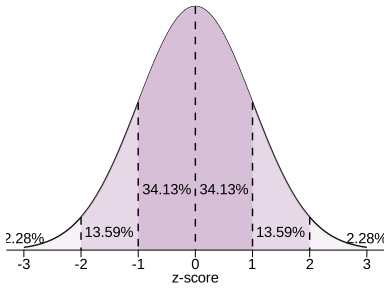
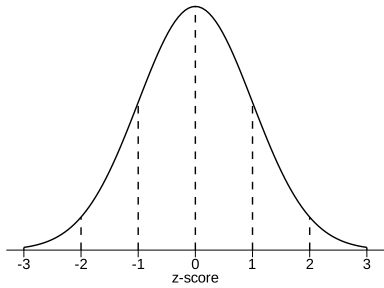
  • \(z\)-scores, normal distributions, probability
    • \(z = \dfrac{X - \mu}{\sigma}\)
    • \(z\)-scores reflect position in population distribution
    • Find probabilities using Unit Normal Table / pnorm()
Recap
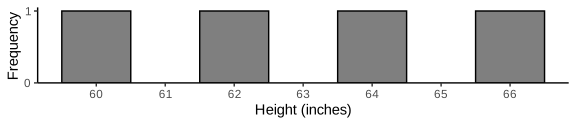
Sample X1 X2 M
1 60 60 60
2 62 60 61
3 64 60 62
4 66 60 63
5 60 62 61
6 62 62 62
7 64 62 63
8 66 62 64
9 60 64 62
10 62 64 63
11 64 64 64
12 66 64 65
13 60 66 63
14 62 66 64
15 64 66 65
16 66 66 66
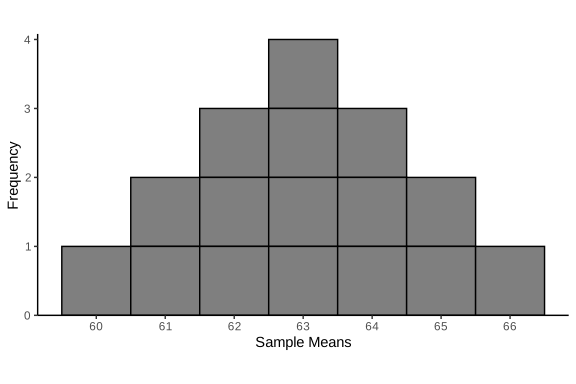
  • Sampling distribution
    • Find probabilities of sample means

\(p(M < 61) =\ ?\)

Central Limit Theorem

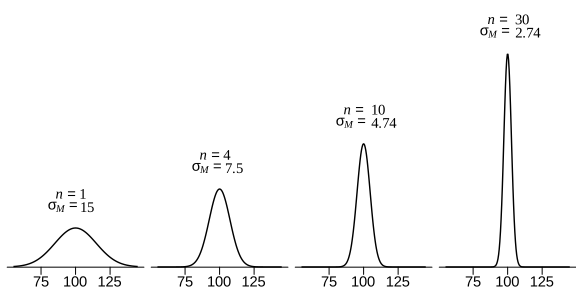
  • Tells us sampling distribution characteristics without having to take all possible samples

\(\mu_M = \mu \ \ \ \ \ \ \ \ \ \ \sigma_M = \dfrac{\sigma}{\sqrt{n}}\)
Together…

  • Sample statistics, normal distributions, probability, Central Limit Theorem
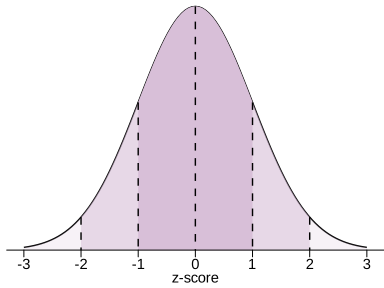
    • We can find \(z\)-score for any sample mean
    • Using characteristics of sampling distribution of the mean \((\mu_M\) and \(\sigma_M)\)
    • Position of given sample mean in the population of all possible sample means
    • Then find probability (using Unit Normal Table / pnorm(), just like for regular \(z\)-scores)

\(z = \dfrac{M-\mu_M}{\sigma_M}\)
Making inferences

  • Sampling error
    • Statistics obtained for a sample will be different from the corresponding parameters for the population
    • Differ from one sample to another
  • Problem:
    • Is difference between sample & population due to treatment effect or sampling error?
  • Addressed by inferential statistics

Treatment

Original
population

Treated
population

Sample

Treated sample

Spiderman

Inferences: Spiderman

  • Are Peter Parker’s RTs “noticeably different?”
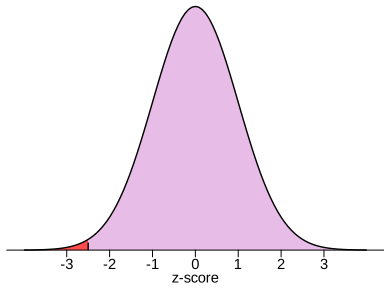
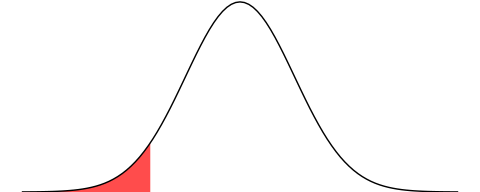
    • \(z = -2.5\)
    • Can state precise probability of observing a \(z\)-score that (or more) extreme

pnorm(-2.5)
[1] 0.006209665
pnorm(159, mean = 284, sd = 50)
[1] 0.006209665

Spidermen

Inferences: spidermen

  • A sample of spidermen (spidermans?)
    • How likely is a particular sample mean, given the population characteristics?
    • Population \(\mu = 284; \sigma = 50\)
  • Single score of \(X = 159\)
  • Find position of that score in population distribution and find probability

\(z = \dfrac{X-\mu}{\sigma} = \dfrac{159 - 284}{50} = -2.5\)

pnorm(-2.5)
[1] 0.006209665
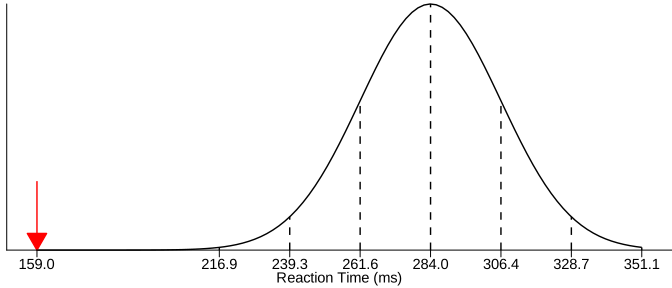
  • Sample mean of \(M = 159\); \(n = 5\)
  • Find position of that \(M\) in sampling distribution and find probability

\(z = \dfrac{M-\mu_M}{\sigma_M} = \dfrac{159 - 284}{50 / \sqrt{5}} = -5.59\)

pnorm(-5.59)
[1] 1.135348e-08

Making inferences: spidermen

  • For sample size \(n = 5\), approximately 0.00000001 of sample means are this (or more) extreme
    • Given how unlikely the mean is, maybe spidermen aren’t from this population
Inferential diagram

Treatment

Known
original
population

Unknown
treated
population

Sample

Treated
sample

Hypothesis testing

  • What do you suspect is going on? Be skeptical
    • Maybe spider bites affect RT
    • But maybe not
  • What are the chances?
    • Think about the probability of sample means
    • Assuming that spider bites do nothing
  • What is the data?
    • Observe actual sample mean
  • Make a decision
    • Compare outcome with predicted probabilities
    • Change your mind if observation seems unlikely enough

Null Hypothesis Significance Testing

  • Step 1: State hypotheses
    • “Null” and “alternative”
  • Step 2: Set decision criteria
    • \(\alpha\) and critical region(s)
  • Step 3: Collect & analyze data
    • Calculate required statistics
  • Step 4: Make decision
    • Compare outcome with predicted probabilities
    • Accept or reject the null hypothesis

1. State hypotheses

  • Null hypothesis: \(H_0\)
    • States that “treatment” has no effect
    • Treated population is indistinguishable from original population
    • No change, no difference, or no relationship
  • Alternative hypothesis: \(H_1\)
    • States that treated population differs from nontreated population
    • There is a change, a difference, or there is a relationship in the general population
  • Logical complements
    • Can’t both be true
    • Ensures falsifiability

1. State hypotheses

  • Claim: This pill makes you smarter
    • \(H_0\): The pill doesn’t effect intelligence
    • \(H_1\): The pill affects intelligence

💊🧠

  • Claim: Standing like superman makes you feel more confident
    • \(H_0\): Posture does not affect confidence
    • \(H_1\): Posture does affect confidence

🦸‍♀ 😎️

  • Claim: The more education people complete, the more they earn
    • \(H_0\): Education is not associated with income
    • \(H_1\): There is a relationship between education and income

🎓🤑

2. Decision criterion

  • If the null hypothesis is true, what sample statistics are likely/unlikely?
    • Central Limit Theorem shows what samples are likely
    • If we get a very unlikely sample, we may reject the null
    • Specific sampling distribution depends on what test is being performed
  • Alpha level & p-value
    • \(\alpha\) (alpha) is the probability value used to define “very unlikely” outcomes
    • p-value is the precise probability of statistics as extreme or more than observed sample statistic, assuming the null hypothesis is correct
    • Typical alpha used by psychologists is \(\alpha = .05\)
    • \(p < .05\); “Statistically significant”

2. Decision criterion

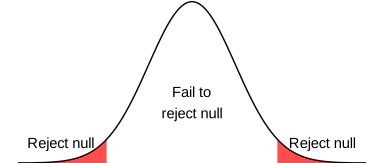
  • Divide distribution of sample means into two parts
    • Outcomes likely if \(H_0\) is true
    • Outcomes unlikely if \(H_0\) is true
    • Boundaries for critical region(s) determined by alpha
2. Decision criterion

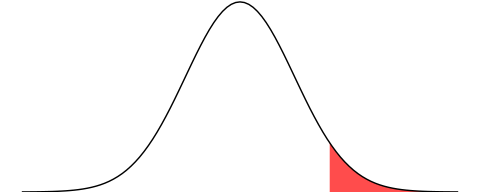
  • Directional tests
    • Researcher has a specific prediction about the direction of the treatment
    • Specifies (in advance) looking for increase or decrease
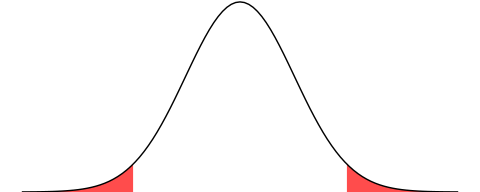
  • Nondirectional tests
    • Looking for a difference in either direction
3. Data collection

  • Randomly sample population of interest
    • Compute a sample statistic to show the exact position (probability) of the sample in the distribution of sample means
    • Exact form of test statistic depends on research design
    • \(z\)-test; \(t\)-test; ANOVA; correlation & regression statistics etc etc etc…

4. Make decision

  • Two possible outcomes:
    • If the sample statistic is not located in critical region(s)
      • Fail to reject null
      • Meaning there does not seem to be an effect
    • Sample statistic is located in critical region(s)
      • \(p < \alpha\)
      • Reject null
      • Meaning there does seem to be an effect

\(z\)-test

  • Appropriate if:
    • Original population \(\mu\) and \(\sigma\) are both known
    • Sampling distribution is normally distributed

Treatment

Known
original
population
\(\mu, \sigma\)

Unknown
treated
population

Sample

Treated sample
\(M, n\)

Spiderman \(z\)-test

  • Formal Spidermen z-test
    • 1: State Hypotheses
      • \(H_0\): Radioactive spiderbites do not alter reaction times
      • \(H_1\): Radioactive spiderbites alter reaction times
    • 2: Decision criteria
      • \(\alpha = .05\) two-tailed; Critical regions are -1.96 and 1.96
    • 3: Collect data; compute statistics & probabilities
      • \(\mu = 284\); \(\sigma = 50\); so if \(n = 5\), \(\sigma_M = 50/\sqrt{5} = 22.36\)
      • \(M = 159\); \(z = (159 - 284) / 22.36 = -5.59\)
    • 4: Decision
      • Observed sample mean is in the critical region
      • \(p < .05\)
      • Reject the null

Learning check

Does CBT affect OCD? (Abramowitz et al., 2010)

  1. State hypotheses

  2. Set decision criteria

    • Decide on alpha, directionality, find \(z\)-scores for critical region
  3. Collect data; compute statistics & probabilities

    • Pre-treatment \(\mu = 30.25\); \(\sigma = 14.89\)

    • Treated sample \(M = 15.49\); \(n = 40\)

  4. Make decision