What is your current level of happiness?
12|THE \(t\)-TEST part 2
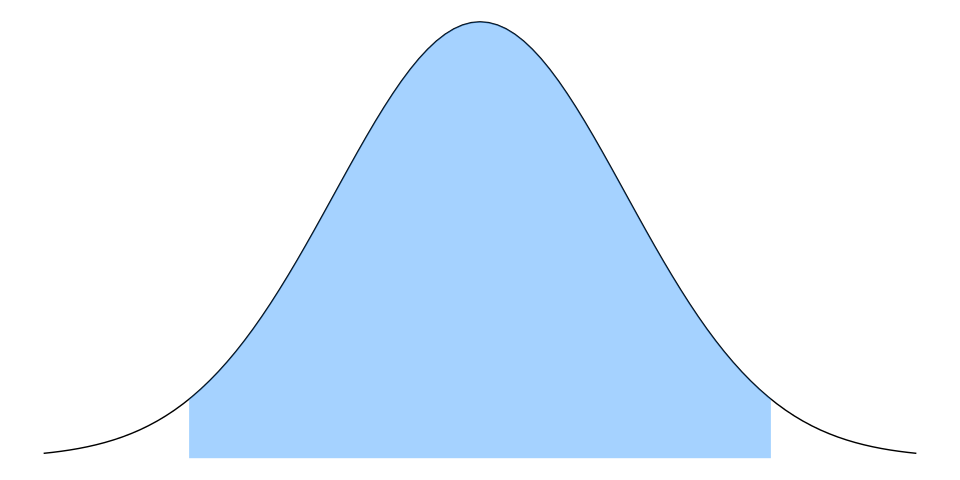
Overview
Research designs
- Single-sample \(t\)-test
- Compare sample against expected population mean based on logic/theory/scale design
- E.g. ‘common sense’ theory
- Population average amount of sleep
\(\mu = 8\) hours
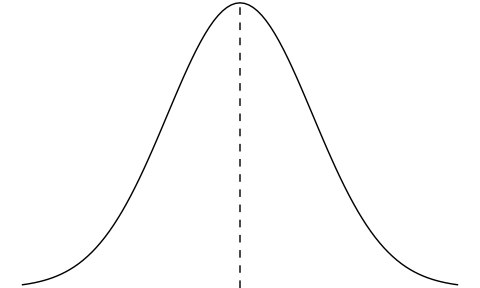
Research designs
- E.g. measure of happiness
\(\mu = 3\)
Assumptions
- Assumptions for single-sample \(t\)-tests
- Independence
- Independent random sampling
- Values in the sample are independent observations
- Normality
- The population sampled is normally distributed
- With large samples \((n > 30)\), this assumption can be violated without affecting the validity of the hypothesis test
- Homogeneity of variance
- Variability in the original and treated populations is the same
- Independence
Effect size
- Hypothesis test Step 4: Make decision (reject null?)
- Step 4b: Evaluate effect size
- Cohen’s \(d\) for single-sample \(t\)-test
- Original equation included population SD, \(\sigma\)
- Estimated Cohen’s \(d\) uses sample SD, \(s\)
\(\text{Estimated } d = \dfrac{\text{mean difference}}{\text{sample standard deviation}} = \dfrac{M - \mu}{s}\)
\(\text{For class RT data, } d = \dfrac{322.59 - 284}{45.31} = 0.85\)
Effect size: \(r^2\)
- Proportion of all variability in the data attributable to treatment effect
- Simplifying assumption: Treatment adds or subtracts a constant to each score
- E.g. 1 point on a scale of 1 to 5
- \(r^2\) separates that variability due to treatment from natural variability between scores
\(r^2 = \dfrac{SS_{treatment}}{SS_{total}}\)
\(r^2\)
- Calculate sum of squared deviations from sample \(M\)
- Variability excluding treatment effect
- \(SS_{without \ treatment}\)
- Calculate \(SS\) from \(H_0\) \(\mu\)
- This is total variability
- \(SS_{total}\)
- Substract \(SS_{without \ treatment}\) from \(SS_{total}\) to find \(SS_{treatment}\)
- Variability attributable to treatment effect
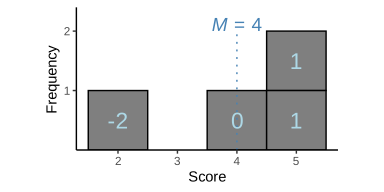
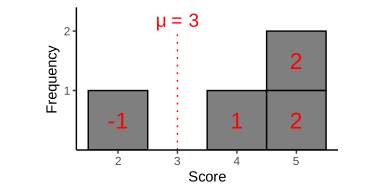
\[\begin{align} r^2 = \dfrac{SS_{treatment}}{SS_{total}} &= \dfrac{SS_{total} - SS_{without \ treatment}}{SS_{total}} \\ &= \dfrac{10-6}{10} = 0.4 \end{align}\]
\(r^2\)
- If we already calculated \(t\)…
\(r^2 = \dfrac{t^2}{t^2 + df}\)
- Works for any kind of \(t\)-test
- Single / related / independent-samples
- Interpreting \(r^2\)
- \(r^2 = 0.01\): small effect
- \(r^2 = 0.09\): medium effect
- \(r^2 = 0.25\): large effect
Reporting results
Given the average reaction time for the population of \(\mu = 284 ms\), according to humanbenchmark.com, a two-tailed single-sample \(t\)-test suggests that BC1101 students have significantly different reaction times \((M = 322.59\); \(SD = 45.31)\) than the general population; \(t(22) =\) \(4.08\), \(p < .05\), \(d = 0.85\).
Confidence intervals
- Complementary to significance & effect size
- Quantifies precision of sample estimate
- Comprised of:
- The point estimate
- Our best guess of the population parameter
- Margin of error
- A range either side of point estimate
- Indicates the amount of uncertainty surrounding estimate of population mean
- Based on desired ‘confidence’, i.e. range of the distribution
- E.g. 95%, 99%, 80%, etc…
- The point estimate
Calculating CI boundaries
- So far, we have been specifying \(\mu\), calculating \(M\) and \(s_M\), solving for \(t\)
- For CI, rearrange to solve for \(\mu\)
- Calculate \(M\) and \(s_M\), specify \(t\) (based on desired width of CI —99%, 95%, 90%, 80% etc), solve for \(\mu\)
\(t = \dfrac{M - \mu}{s_M}\)
\(\mu = M \pm t * s_M\)
Confidence interval interpretation
- What does a confidence interval tell us?
- Indicates precision of parameter estimate
- Quantifies variability around a single point estimate
- NOT “we are 95% sure the true population mean is within this range”
- NOT “sample means from this population will fall within this range 95% of the time”
“The parameter is an unknown constant and no probability statement concerning its value may be made.”1
Factors that affect CI width
30
95
CI & NHST
- \(p\) value and CI always agree about statistical significance if CI is \(1 – alpha\)
- E.g. \(\alpha = .05\) and 95% confidence interval
- If the \(p < \alpha\), the confidence interval will not contain the null hypothesis value
- If the confidence interval does not contain the null hypothesis value, the results are statistically significant
- Both significance level and confidence level define a distance from a mean to a limit
- The distances in both cases are exactly the same
CI & NHST demonstration
15
0.7
Show:
p
Learning checks
- What value of \(t\) would you expect to see if the null hypothesis is true?
- Which combination of factors is most likely to produce a significant value for the \(t\) statistic?
- Small mean difference and large sample variability
- Small mean difference and small sample variability
- Large mean difference and large sample variability
- Large mean difference and small sample variability
jStat = require("../js/jstat.js")

ci = {

  const w = 1050, h = 600;
  const margin = {bottom: 30};
  const f = d3.format(".2f");
  var mean, sd, confidence, n, std_err, xlim, ci_x_lim;

  const x = d3.scaleLinear()
    .range([0, w])
  const xRaw = d3.scaleLinear()
    .domain([-1, 1])
    .range([0, w])
  const y = d3.scaleLinear()
    .domain([0, 0.43])
    .range([h - margin.bottom, 0])
  const line = d3.line()
    .x(d => x(d.value))
    .y(d => y(d.density));
  const xAxis = d3.axisBottom(x);
  const xAxisRaw = d3.axisBottom(xRaw).tickSize(10);

  function makeCurve(xlim) {
    var arr = [];
    var x = jStat(-xlim, xlim, 210)[0];
    for (var i = 0; i < x.length; i++) {
      arr.push({value: x[i], density: jStat.studentt.pdf(x[i], n - 1)})
    }
    return arr
  }

  const svg = d3.select("#ci-container").append("svg")
    .attr("width", w).attr("height", h)

  const axis = svg.append("g")
    .attr("transform", `translate(0, ${y(0)})`)
    .style("color", "steelblue")
    .call(xAxis);

  const axisRaw = svg.append("g")
    .attr("transform", `translate(0, ${y(0)})`)
    .call(xAxisRaw);

  const defs = svg.append("defs")
  const mask = defs.append("mask").attr("id", "mask")
  const mask_rect = mask.append("rect")
  .attr("height", h)
  .style("fill", "white")

  const ci_fill = svg.append("path")
    .attr("mask", "url(#mask)")
    .style("stroke", "none").style("fill", "lightblue")

  const ci_curve = svg.append("path")
    .attr("class", "invertable")
    .style("stroke", "black")
    .style("fill", "none")
    .style("stroke-width", 4)

  const ci_line = svg.append("line")
    .style("stroke", "black").style("stroke-dasharray", [5,5])

  const ci_point_estimate = svg.append("line")
    .style("stroke", "black").style("stroke-dasharray", [5,5])

  const ci_limit_labels = svg.append("g")
  const ci_limit_lower = ci_limit_labels.append("text")
  const ci_limit_upper = ci_limit_labels.append("text").style("text-anchor", "end")

  const inputCI =  d3.select("#input-ci")
  const inputN =  d3.select("#input-n")
  const inputMu =  d3.select("#input-mu")
  const inputSigma =  d3.select("#input-sigma")

  function initialize() {
    mean = Number(inputMu.property("value"));
    sd = inputSigma.property("value");
    confidence = inputCI.property("value");
    n = inputN.property("value");
    std_err = sd / Math.sqrt(n);
    updateCI();
  }

  inputMu.on("input", function() {
    mean = Number(this.value);
    updateCI();
  })

  inputSigma.on("input", function() {
    sd = Number(this.value);
    std_err = sd / Math.sqrt(n);
    updateCI();
  })

  inputCI.on("input", function() {
    confidence = Number(this.value);
    d3.select("#value-ci").text(confidence);

    updateCI();
  })

  inputN.on("input", function() {
    n = Number(this.value);
    d3.select("#value-n").text(n);
    std_err = sd / Math.sqrt(n);

    updateCI();
  })

  function updateCI() {
    xlim = sd / std_err;
    x.domain([-xlim, xlim]);
    axis.call(xAxis);
    xRaw.domain([mean - sd, mean + sd]);
    axisRaw.call(xAxisRaw);

    ci_x_lim = jStat.studentt.inv((1 - (confidence/100)) / 2, n - 1);
    var line_height = jStat.studentt.pdf(ci_x_lim, n-1) / 2;

    var ci_lims = [mean + ci_x_lim * std_err, mean - ci_x_lim * std_err];

    ci_limit_lower
      .text(f(ci_lims[0]))
      .attr("x", x(ci_x_lim))
      .attr("y", y(line_height))
    ci_limit_upper
      .text(f(ci_lims[1]))
      .attr("x", x(-ci_x_lim))
      .attr("y", y(line_height))

    ci_fill.attr("d", line(makeCurve(15)))
    ci_curve.attr("d", line(makeCurve(xlim)))

    mask_rect
      .attr("x", x(ci_x_lim))
      .attr("width", x(-ci_x_lim) - x(ci_x_lim));

    ci_line
      .attr("transform", `translate(0, ${y(line_height)})`)
      .attr("x1", x(-ci_x_lim)).attr("x2", x(ci_x_lim))
    ci_point_estimate
      .attr("transform", `translate(${x(0)}, 0)`)
      .attr("y1", y(jStat.studentt.pdf(0, n - 1))).attr("y2", y(0))
  }

  initialize();
}
ci_nhst = {
const w = 1050, h = 500;
const margin = {bottom: 5};
const xlim = [-1, 1.5];
const sigma = 1;
const confidence = 95;
var cohensD, n, std_err, ci_x_lim;
const x = d3.scaleLinear()
.domain(xlim)
.range([0, w])
const y = d3.scaleLinear()
.domain([0, 2])
.range([h - margin.bottom, 0])
const line = d3.line()
.x(d => x(d.value))
.y(d => y(d.density));
const xAxis = d3.axisBottom(x);
function makeCurve(mu, std_err) {
var arr = [];
var x = jStat(xlim[0], xlim[1], 210)[0];
for (var i = 0; i < x.length; i++) {
arr.push({value: x[i], density: jStat.normal.pdf(x[i], mu, std_err)})
}
return arr
}
function makeFill(mu, std_err) {
var arr = [];
var x = jStat(-5, 5, 310)[0];
for (var i = 0; i < x.length; i++) {
arr.push({value: x[i], density: jStat.normal.pdf(x[i], mu, std_err)})
}
return arr
}
const svg = d3.select("#ci-nhst-container").append("svg")
.attr("width", w).attr("height", h)
<!-- const axis = svg.append("g").attr("transform", `translate(0, ${y(0)})`).call(xAxis); -->
const ci_dist = svg.append("g")
const null_dist = svg.append("g")
const defs = svg.append("defs")
const mask = defs.append("mask").attr("id", "nhst-mask")
const mask_rect = mask.append("rect")
.attr("height", h)
.style("fill", "white")
const null_mask = defs.append("mask").attr("id", "null-mask")
null_mask.append("rect").attr("width", w).attr("height", h).style("fill", "white")
const null_rect = null_mask.append("rect")
.attr("height", h)
.style("fill", "black")
const null_fill = null_dist.append("path")
.attr("mask", "url(#null-mask)")
.style("stroke", "none")
.style("fill", "red")
.style("opacity", 0.7)
const null_curve = null_dist.append("path")
.attr("class", "invertable")
.style("stroke", "red")
.style("fill", "none")
.style("stroke-width", 4)
.style("stroke-dasharray", [10, 10])
const null_mu = null_dist.append("line")
.attr("transform", `translate(${x(0)}, 0)`)
.attr("y1", y(0))
.style("stroke", "red").style("stroke-dasharray", [5,5])
const null_margin = null_dist.append("line")
.style("stroke", "red").style("stroke-dasharray", [5,5])
const ci_fill = ci_dist.append("path")
.attr("mask", "url(#nhst-mask)")
.style("stroke", "none").style("fill", "lightblue")
const ci_curve = ci_dist.append("path")
.attr("class", "invertable")
.style("stroke", "black")
.style("fill", "none")
.style("stroke-width", 4)
const ci_line = ci_dist.append("line")
.style("stroke", "black").style("stroke-dasharray", [5,5])
const ci_point_estimate = ci_dist.append("line")
.style("stroke", "black").style("stroke-dasharray", [5,5])
const p_value = svg.append("text")
.attr("transform", `translate(${w * 0.75}, ${h * 0.25})`)
.style("color", "var(--text-color)")
.attr("class", "math")
const inputCohensD = d3.select("#input-cohens-d")
const inputN = d3.select("#input-nhst-n")
function initialize() {
cohensD = Number(inputCohensD.property("value"));
n = Number(inputN.property("value"));
std_err = sigma / Math.sqrt(n);
updateCI();
}
inputCohensD.on("input", function() {
initialize();
d3.select("#value-cohens-d").text(cohensD);
})
inputN.on("input", function() {
initialize();
d3.select("#value-nhst-n").text(n);
})
function updateCI() {
null_fill.attr("d", line(makeFill(0, std_err)));
null_curve.attr("d", line(makeCurve(0, std_err)));
null_rect
.attr("x", x(jStat.normal.inv(0.025, 0, std_err)))
.attr("width", x(jStat.normal.inv(0.975, 0, std_err)) -
x(jStat.normal.inv(0.025, 0, std_err)))
null_mu.attr("y2", y(jStat.normal.pdf(0, 0, std_err)))
null_margin
.attr("transform", `translate(0, ${y(jStat.normal.pdf(jStat.normal.inv(0.025, 0, std_err), 0, std_err))})`)
.attr("x1", x(0))
.attr("x2", x(jStat.normal.inv(0.975, 0, std_err)))
var ci_lim_lower = jStat.normal.inv(0.025, cohensD, std_err);
var ci_lim_upper = jStat.normal.inv(0.975, cohensD, std_err);
var ci_lims = [ci_lim_lower, ci_lim_upper];
var line_height = jStat.normal.pdf(ci_lims[0], cohensD, std_err) / 2;
ci_fill.attr("d", line(makeFill(cohensD, std_err)))
ci_curve.attr("d", line(makeCurve(cohensD, std_err)))
mask_rect
.attr("x", x(ci_lims[0]))
.attr("width", x(ci_lims[1]) - x(ci_lims[0]));
ci_line
.attr("transform", `translate(0, ${y(line_height)})`)
.attr("x1", x(ci_lims[0])).attr("x2", x(cohensD));
ci_point_estimate
.attr("transform", `translate(${x(cohensD)}, 0)`)
.attr("y1", y(jStat.normal.pdf(cohensD, cohensD, std_err))).attr("y2", y(0))
var significant = ci_lims[0] > 0;
var p_value = d3.select("#p-value");
if (significant) {
ci_fill.style("filter", "grayscale(0)");
p_value.text("< .05 🥳");
} else {
ci_fill.style("filter", "grayscale(1)");
p_value.text("> .05");
}
}
d3.select("#h0").on("input", showSelected);
d3.select("#h1").on("input", showSelected);
d3.select("#both").on("input", showSelected);
function showSelected() {
var h0 = d3.select("#h0").property("checked");
var h1 = d3.select("#h1").property("checked");
var both = d3.select("#both").property("checked");
var selected = [false, false];
if (h0 || both) { selected[0] = true; }
if (h1 || both) { selected[1] = true; }
null_dist.classed("hide-element", !selected[0]);
ci_dist.classed("hide-element", !selected[1]);
d3.select("#p-value-container").classed("hide-element", !both)
}
initialize();
}