What is your current level of happiness?
13|INDEPENDENT-SAMPLES \(t\)-TEST
Overview
Research design
Single-sample \(t\)-test design
- Compare sample against expected population mean based on logic/theory/scale design
- E.g. give everyone $10 💵
\(\mu = 3\)
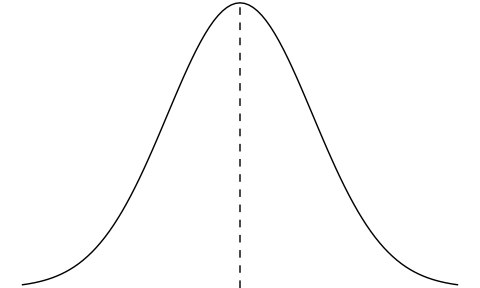
Single-sample \(t\)-test logic
Partially known
original population
\(\mu\)
Unknown
treated
population
Sample
Treated sample \(n, M, SD\)
Independent-samples design
What if… give everyone $10
Group A:
Spend this on yourself 💵
What is your current level of happiness?
Group B:
Spend this on someone else 💵
What is your current level of happiness?
Dunn, E. W., Aknin, L. B., & Norton, M. I. (2014). Prosocial spending and happiness: Using money to benefit others pays off. Current Directions in Psychological Science, 23(1), 41-47. https://doi.org/10.1177/0963721413512503
Independent-samples \(t\)-test logic
Unknown
treated population
A
Unknown
treated population
B
Sample A
\(n, M, SD\)
Sample B
\(n, M, SD\)
Calculation
Basic structure of all \(t\)-tests:
\(t = \dfrac{ \text{sample statistic} - \text{population parameter} }{\text{estimated standard error}}\)
\(t = \dfrac{ \text{how different was observed from predicted?} }{\text{how big a difference would we expect by chance?}}\)
\(t = \dfrac{ \text{data} - \text{hypothesis} }{\text{error}}\)
Single-sample \(t\)
\(t = \dfrac{M-\mu}{s_M}\)
Independent-samples \(t\)
\(t = \dfrac{(M_1-M_2)-(\mu_1-\mu_2)}{s_{M_1-M_2}}\)
Equations
- Denominator: \(s_{M_1-M_2}\)
- Estimated standard error of the mean difference
- Estimated standard error of the mean difference
\(s_{M_1-M_2} = \sqrt{\dfrac{s_p^2}{n_1}+\dfrac{s_p^2}{n_2}}\)
- \(s_p^2\): Pooled variance
- Weighted average of two sample variances
\(\begin{align} s_p^2 = &\dfrac{SS_1+SS_2}{df_1+df_2} \\ \\ \text{or... } &\dfrac{df_1*s_1^2 + df_2*s_2^2}{df_1+df_2} \\ \text{because... } s^2 = &\dfrac{SS}{df} \text{ so... } SS = df*s^2 \end{align}\)
Calculating independent samples \(t\)
- Pooled variance: \(s_p^2 = \dfrac{SS_1+SS_2}{df_1+df_2}\)
- Estimated standard error of mean difference: \(s_{M_1-M_2} = \sqrt{\dfrac{s_p^2}{n_1}+\dfrac{s_p^2}{n_2}}\)
- \(t\) statistic: \(t = \dfrac{(M_1-M_2)-(\mu_1-\mu_2)}{s_{M_1-M_2}}\)
Hypothesis test
Step 1: State hypotheses
- Null: There is no difference between groups
- The treatment has no effect
- \(μ_1 – μ_2 = 0\)
- Alternative: There is a difference
- The treatment has an effect
- Directional: \(μ_1 – μ_2 < 0\) or \(μ_1 – μ_2 > 0\)
- Nondirectional: \(μ_1 – μ_2 \ne 0\)
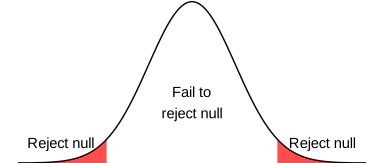
Step 2: Define critical region
- Depends on \(\alpha\) and \(df\)
\[
\begin{align}
df &= df_1 + df_2 \\
&= (n_1 – 1) + (n_2 – 1) \\
&= N - 2
\end{align}
\] 
Proportion in 1 tail |
0.025 |
|---|---|
| Proportion in 2 tails |
0.05 |
| 1 | 12.706 |
| 2 | 4.303 |
| 3 | 3.182 |
| 4 | 2.776 |
| 5 | 2.571 |
| 6 | 2.447 |
| 7 | 2.365 |
| \(df\) 8 | 2.306 |
| 9 | 2.262 |
| 10 | 2.228 |
| 11 | 2.201 |
| 12 | 2.179 |
| 13 | 2.160 |
| 14 | 2.145 |
| 15 | 2.131 |
| ... | ... |
Step 3: Calculate \(t\) statistic
Spend $10 on self
| \(X\) | \(X-M\) | \((X-M)^2\) |
|---|---|---|
| 1 | -2 | 4 |
| 5 | 2 | 4 |
| 2 | -1 | 1 |
| 4 | 1 | 1 |
| 3 | 0 | 0 |
| \(M = 3.00\) | \(SS = 10.00\) | |
| \(s^2 = 2.50\) | ||
| \(s = 1.58\) |
Spend $10 on other
| \(X\) | \(X-M\) | \((X-M)^2\) |
|---|---|---|
| 5 | 1 | 1 |
| 5 | 1 | 1 |
| 2 | -2 | 4 |
| 5 | 1 | 1 |
| 3 | -1 | 1 |
| \(M = 4.00\) | \(SS = 8.00\) | |
| \(s^2 = 2.00\) | ||
| \(s = 1.41\) |
Step 3 : Calculate \(t\) statistic
\(s_p^2 = \dfrac{SS_1+SS_2}{df_1+df_2} = \dfrac{10 + 8}{4 + 4} = 2.25\)
\(s_{M_1-M_2} = \sqrt{\dfrac{s_p^2}{n_1}+\dfrac{s_p^2}{n_2}} = \sqrt{\dfrac{2.25}{5}+\dfrac{2.25}{5}} = 0.95\)
\(t = \dfrac{(M_1-M_2)-(\mu_1-\mu_2)}{s_{M_1-M_2}} = \dfrac{3 - 4}{0.95} = -1.05\)
Step 4: Make decision
Step 4b: Effect size
- Cohen’s \(d\) for independent samples
\[\begin{align} d &= \dfrac{\text{difference between means}}{\text{pooled standard deviation}} \\ &= \dfrac{(M_1 - M_2) - (\mu_1 - \mu_2)}{\sqrt{s^2_p}} \\ &= \dfrac{3 - 4}{\sqrt{2.25}} \\ &= -0.67 \end{align}\]
- Note: not required for nonsignificant differences
Step 5: Report results
A two-tailed independent-samples \(t\) test suggested that the difference in average happiness between people in the “Spend on self group” \((M = 3\); \(SD = 1.58)\) and the “Spend on other” group \((M = 4\); \(SD = 1.41)\) was nonsignificant; \(t(8) =\) \(-1.05\), \(p > .05\).
Assumptions
Assumptions for independent-samples \(t\)-tests
- The observations within each sample must be independent
- The two populations from which the samples are selected must be normal
- Can be ignored with large enough sample size
- The two populations from which the samples are selected must have equal variances
- Homogeneity of variance
- Because pooled variance is a weighted average
Homogeneity of variance
- Testing the homogeneity of variance assumption
- Hartley’s F-max test
\(F_{max} = \dfrac{s^2_{largest}}{s^2_{smallest}}\)
- Small value (near 1) indicates similar sample variances, larger values indicate larger difference
- Look up associated critical value for \(F\)-max test
- If value exceeds critical value, indicates homogeneity assumption has been violated
Homogeneity of variance correction
- If homogeneity of variance assumption is violated…
- Calculate standard error without pooled variance
- Adjust \(df\) using equation:
\[df = \dfrac{(\dfrac{s_1^2}{n_1}+\dfrac{s_2^2}{n_2})} {\dfrac{(\dfrac{s_1^2}{n_1})^2}{n_1-1} + \dfrac{(\dfrac{s_2^2}{n_2})^2}{n_2-1} }\]
Homogeneity of variance correction
- …or let R do the work for you
t.test()function automatically applies correction- Specify
var.equal = TRUEto override
    Welch Two Sample t-test

data:  conditionA and conditionB
t = -1.0541, df = 7.9024, p-value = 0.323
alternative hypothesis: true difference in means is not equal to 0
95 percent confidence interval:
 -3.192378  1.192378
sample estimates:
mean of x mean of y
        3         4
    Two Sample t-test

data:  conditionA and conditionB
t = -1.0541, df = 8, p-value = 0.3226
alternative hypothesis: true difference in means is not equal to 0
95 percent confidence interval:
 -3.187668  1.187668
sample estimates:
mean of x mean of y
        3         4
Confidence interval
- Quantifies precision of point estimate
- Distribution of differences between two samples drawn from identical populations
Rearrange \(t\) equation:
\(t = \dfrac{(M_1-M_2)-(\mu_1-\mu_2)}{s_{M_1-M_2}}\)
To solve for parameter \((\mu_1 - \mu_2)\):
\((\mu_1-\mu_2) = (M_1-M_2) \pm t * s_{M_1-M_2}\)
Confidence interval
\[\begin{align} (\mu_1 - \mu_2) &= (M_1 - M_2) \pm t * s_{M_1 - M_2} \\ &= -1 \pm 2.31 * 0.95 \\ &= -3.19, 1.19 \end{align}\]
Learning checks
- A researcher performing an independent-samples \(t\)-test finds a difference between groups of 2.3, and calculates a 95% confidence interval of [0.3, 4.3]. Can you predict whether the hypothesis test will reject the null hypothesis?
- It will reject the null
- It will fail to reject the null
- Cannot make a prediction
- A confidence interval for an independent-samples test which includes a value of zero within its confidence range establishes that true population parameter is 95% certain to be zero.
- True
- False
cover = {
  const w = 1050
  const h = 500
  const x = d3.scaleLinear()
    .domain([40,180])
    .range([0,w])
  const y = d3.scaleLinear()
    .domain([0,70])
    .range([h,0])
  const fill = d3.scaleOrdinal()
    .domain(["A","B", "AB"])
    .range(["#dda6a6", "#b0d3ff", "#9c9ecb"])

  const svg = d3.select("#cover").append("svg").attr("width", w).attr("height", h)

  svg.selectAll("rect").data(data).enter().append("rect")
    .attr("x", d => x(d.value))
    .attr("y", d => y(d.y_cum))
    .attr("width", 6)
    .attr("height", 6)
    .style("fill", d => fill(d.group))
}