About
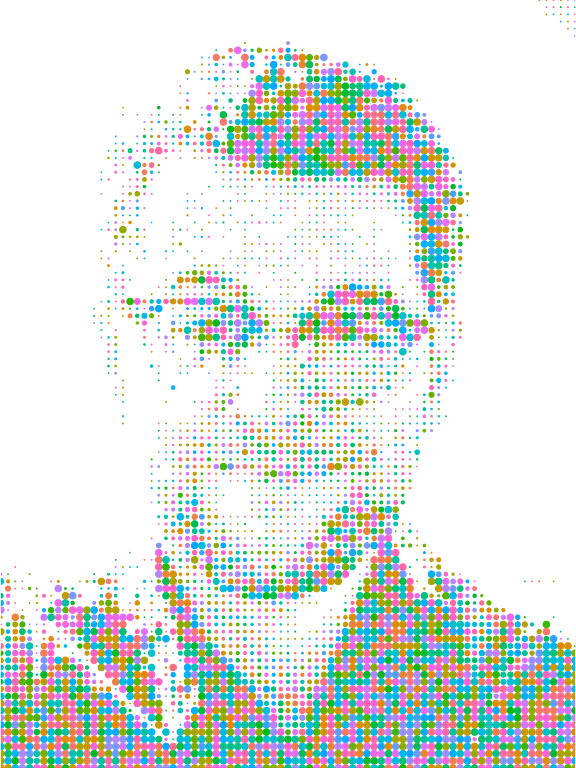
This site collects together some of the visualizations and games I’ve made as part of my statistics course. Statistics, at its core, is about understanding the patterns and principles that shape our world. It’s more than just a set of abstract equations. To help bring this vision to life, I created an array of interactive visualizations and games. Rather than just learning about a statistical concept like the Central Limit Theorem, these help you to experience it in action, to see the narratives that numbers can create. My hope is to bridge the gap between abstract equations and hypothetical distributions and the real, messy processes that somehow produce those predictable patterns. Seeing these basic processes in action goes a long way towards understanding how statistical stories play out in our day-to-day lives.
The design philosophy is grounded in the notion that statistics is a tactile, organic, and sometimes messy process. The visualizations I use show statistical populations not as abstract curves, but as hundreds of individual dots piled up into a normal (or not-so-normal) distribution. When you draw a sample from these populations, you can see and interact with the specific dots that have been selected, keeping track of the progression from the individual to the aggregate. This is designed to instill a sense of the concrete nature of statistics, reinforcing that behind every data point there is a story.
This approach to bringing statistics to life also shapes my choice of visual design. I use bright colors and a ‘sketchy’ theme that harks back to a time of hand-drawn graphs and chalkboard equations. The intention is to remind users that what they are interacting with is not a dry, abstract mathematical concept, but a dynamic process that reflects the vibrant, sometimes chaotic reality of our world. It’s about more than numbers – it’s about people, processes, and the patterns that tie it all together.